Which is the interesting part. This is the long version — Louisiana, a soccer career that ended without telling me, a vodka from Mongolia that was not from Mongolia, and an RV that couldn't get over a bridge, which is the only reason I live where I live. If you want the version where everything went great, that's a résumé, and it's boring.
My parents are still in love.
Weird way to open a website. Also the load-bearing fact of my entire life, so it goes first.
They came to everything. Every game. Every dream I announced at dinner. Every idea that, in hindsight, was NOT an idea. And somehow they got me believing I could be any of it — a thing I have never recovered from and don't intend to.
I was a chunky kid who wanted abs. Mom said do . I did. Two months. Nothing. She looked right at me and said, "You've got abs, honey. You just can't see them yet."
It's already possible. You're just early.
And that house was never only us. Cousins, aunts, uncles — everybody took their turn living with us. Kat's best friend spent more time at our place than her own. There are people who came through that door I call my brother, my sister. Not as a figure of speech.
Nobody sat us down and announced this as a Family Value. Door was open. Mom or Dad saw a kid who needed parenting, they parented them. That's the whole policy.
Then my mom got so good at being a mom she went and built a . More kids than just us.
Start from "of course you can." You'll be wrong sometimes, and it's still the better place to be wrong from.
Kindness isn't the soft part of this job. It's the part that gets people to tell you the truth, and the truth is the only raw material I've ever had.Number 12. Five foot seven, a hundred and forty-seven pounds, and I can jump maybe .
Mississippi College, then Belhaven. Then Brazil, which is the part people should actually be asking about.
One of my teachers had been a soccer agent in a previous life, and he was going to Brazil for the summer, and that was the whole plan. Six months of bussing tables at night, class in the morning, training every afternoon, plus every graduation-gift check anybody handed me. I landed in Rio on , chasing a contract.
I had paid a man to sort out my visa and he took the money and vanished. So I lived with a teammate, shared a bed, bounced club to club, and learned Portuguese one inappropriate phrase at a time. For a stretch I stayed in a friend's house at the end of an unpaved road, with trees dragged across the street by drug lords to keep the police out and newspaper stuffed into the holes in the tin roof to keep the bugs out. Three months, no hot shower. Duque de Caxias is where the local press wrote about the small American considerably more than the small American deserved.
And then there was the beach. Brazil–Chile went to penalties and I watched forty thousand people on Copacabana go completely silent at the same instant — no samba, no songs, nobody breathing — and Brazil missed the first one. Grown men sobbed. The last kick got saved, the whole beach detonated, and five minutes later I was shirtless, had lost every object I was carrying, and had never been happier in my life.
The final was the other side of the same coin. A hundred thousand Argentinians, twenty thousand Germans, a handful of Americans, one me. Germany scored in extra time and the sand turned into a brawl — chairs going past my head, beer cans as ammunition — and there I was yelling "¡Tranquilo, tranquilo!" in an American accent, to . Greatest game on earth. Also a mirror, and the world it reflects is flawed.
Philadelphia came after, on the way down — lower-level American teams, one contract at a time, the stretch where you can still call it a career if you say it fast.
Here's what being small does to you. You can't win anything in the air and you can't out-muscle a single person on the field, so you have to know where the ball is going before it goes there. That isn't a talent. It's the only strategy available to you, and you get very good at it because the alternative is not playing.
Then it ends, and nobody tells you which day it is. The body stops recovering the way it used to, the money was never there to begin with, and the doors above you quietly stop opening.
Then, one day, out of nowhere really, you realize it's time for something new. I realized it when I burst into a monumental amount of tears watching . Mike wasn't meant to be a Scarer. He was a better coach. Maybe I wasn't meant to be a player, but something else too?
And so a new exploration began. A new language, a newish love, and a very VERY loose life plan: learn ideas and see what happens. First I needed some money, because adventures require capital and my bank account was running on fumes from the previous dream.
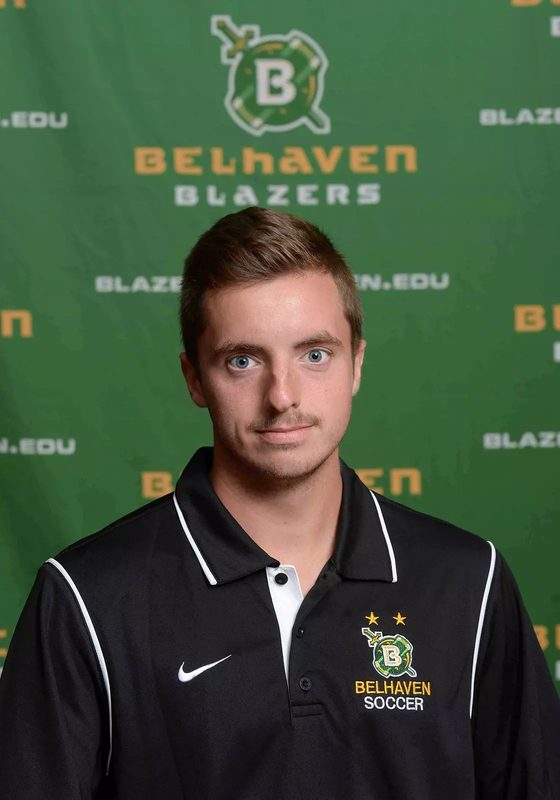
Belhaven, 2013. Still the fastest thing on this page.If you can't be the biggest one out there, see the play two touches earlier than everybody else.
It's also how I run a room. I'm not the loudest person in it. I just already know where the ball is going.What do you do when the only skill you have is kicking a small round object around an open field with other men?
You go look at the other skills you do have. Some writing. Good at speaking English. Former snow elf at a children's museum. And you become… a tutor?
More like a manny. I became a manny for an extremely kind family in the posh part just outside of Philly, and what I actually found there was a great friend in my devious, genius, spastic new baby to sit: a thirteen-year-old boy.
Lots of energy. Some dashes of confused rage. An ability to manipulate almost any situation. But above all, a huge heart and an unreal talent for dark jokes. He was me, with a different childhood and different ingredients peppering his decisions.
At the same time I needed more money, and I had more time (less soccer), so I arrived at the most logical next step available to a man in my position: .
As random as it came to me, it came to the founder. A trip to Mongolia, a friendship with Mongolia's prime minister, an alarmingly similar design to every other bottle on the shelf, and the company was off to the races. The product was Golia, and the pitch — which I delivered out loud, to strangers, with a completely straight face — was that it was Mongolia's finest.
Vodka is all the same. That's the thing nobody in that business will say to you. So what I was actually selling was a story, at two in the afternoon, to a bar manager who had heard of neither the vodka nor me, and both of those facts were obvious to him inside about four seconds.
A hundred doors a week teaches you something no design book can: a no is cheap. It costs eleven seconds. If you can collect a hundred of them by Friday you know more about your idea than you'd learn in a year of keeping it safe on your laptop.
But underneath the manny job and the vodka I was doing something else, which I can only see now. Soccer had been the dream since I was a child, and when a dream that size ends you don't stop needing one — you go looking for something to put in the empty slot. What I put in it was a girl. She was Spanish, I met her in Philadelphia, and I made her into my — the thing worth moving countries for. That is the actual reason I got on a plane to Spain. Not a master's, not a plan. A new dream, and I had picked one that could leave.
A no is data, and it's cheap. Go get a hundred of them.
Everything I believe about killing an idea for twenty dollars before it costs you a year started on a Philadelphia sidewalk, not in a book.Spanish “People from Murcia are idiots.”
That's what people said to me, laughing, every single time I told them where I was going to study. They don't even speak Castilian down there. They live in the orchard. They sunbathe, they eat oranges, there's nothing.
I was going for a master's in innovation and tourism marketing, which I want on the record as the least likely credential in this entire story.
They had painted Murcia for me as a calabaza — a pumpkin — and honestly I was scared to arrive. The train did not help. October, window seat, and outside the glass was sand and mountains and desert, a world that looked more like Star Wars than Earth. I got there under a cloud of dust, into a heat that could kill you, and said out loud: what have I done.
Then I walked into the most creative room I have ever stood in. A studio called , where innovation wasn't a quarterly initiative, it was a Tuesday — Greeks, Filipinos, Canadians, Belgians, one American, and a guy from Cehegín, all around a table buried in Playmobil, lateral thinking as the house language. I came to Murcia to learn Spanish. I stayed because I had never been anywhere more inventive. The region that supposedly has nothing gave the world the submarine and the man who figured out the helicopter.
So I stopped defending the place and joined it. I wrote a column in murciano under the byline Juanico Saye, Americanico. I went looking for the orchard everybody warned me about and never found it — oranges everywhere, sure, that part is true, but what I actually found was a culture of making things.
I came to Murcia to learn Spanish. I stayed because I had never stood anywhere more inventive. And I decided that if I do like the murcianos do, I'll keep finding innovation. Acho.
The place everybody laughs at is the place nobody is competing for.
Murcia gave the world the submarine and the man who worked out the helicopter. I went there for the language and accidentally picked up the career.No home, no job, twenty-seven days left on an expiring visa, and a breakup fresh enough to still have a pulse. I was sleeping on the floor of my Italian friend apartment, in the hottest city in Spain, in a desert, with no air conditioning. I say that to paint the picture, not to be felt sorry for. Life was making me its pretty little boyfriend and I was thoroughly not enjoying it.
A hundred and five CVs. Four countries. Two callbacks. (I would find out later why.)
Callback one: write about yachts in Valencia and travel to Monaco documenting all its glory and wealth. A legitimate, paying job. But I have never been farther from a coast than boogie-boarding in north Florida, and rich things make me uncomfortable (possibly envious). So I put everything into Big Blue.
One email. Then a game of tag — calls, emails, whatever it took — in July and August, which I did not yet know are the unofficial official NO ONE WORKS months of the Spanish calendar. And luck, in the form of Maite Iniesta: Murciana, young enough to think different was good, and patient enough not to get mad when I called her while she was sunbathing on her vacation.
She's the one who eventually told me why my CV survived the pile. One: there was a photo in the corner of me , which HR found weird, and in a stack of hundreds of CVs with identical beginnings, middles and ends, weird was the only thing legible. Two: professional athlete to vodka salesman is a strange list of jobs, but underneath it was real design thinking with real clients. Three: I would not go away, without ever quite becoming pesado.
Then the tests. Logic: passed, magically. Math, word problems, in Spanish: passed? (I assume a curve.) English: crushed it, still mad about the two I missed.
Then the group dynamic. Twenty chairs around one square table, ringed by managers and HR. Everyone taller than me. Everyone Spanish. Everyone holding a degree in something like engineering or telecommunications. Cool — I studied journalism and can draw alright. Maite herded us in like cattle to what she called , and like that, the Hunger Games began.
Introductions first. IN. ENGLISH. I nearly cried at my luck.
Then they set the room a problem, and the loudest people immediately started fighting over the microphone, which is what a group dynamic actually is. Halfway through, the realization: this is a design thinking workshop. I don't have to win it. I can guide it. So I helped frame the problem instead of competing for it, and when we had a solution and nothing to show for it, I drew it — a genuinely bad pen sketch of an augmented-reality chair on a webpage. Instinct. Luck. That was my entire contribution. Why didn't you learn Spanish better, idiot, I said to myself on the way out.
Then, because Spain, the whole group went straight to the nearest bar. I had two beers on a stomach that had had nothing in it all day — one for the nerves, one for the breakup, and mostly because I was dying of thirst. My phone rang. Maite. She'd been hunting for my number for an hour, because I had . Good one, John John.
My interview was in five minutes. I did it slightly drunk and answered everything honestly, which is not a technique I recommend but is the one I used. Have you ever designed a website? No. An app? Concepts, never the screens. What have you designed? Brands, campaigns, a lot of juice, packaging, a clothing line. Would you learn to program? I learned to speak Spanish like this in six months. It's just another language.
Maybe that awful drawing wasn't so awful. They called. I took the job without owning a computer.
It turned into , an automation-opportunity series that got used across IBM Europe, and client work in the tens of millions.
What I expected was that big companies would have big-company problems. They don't. Two hundred and fifty rooms — banks, telcos, energy, retail, three countries — and it is the same six problems every single time, wearing a badge and a budget. People are people. The logo changes. The problem is the problem.
Which was good news, actually, because it meant the thing that worked in the first room was going to work in the two hundredth. You cannot hire enough geniuses. You can teach a lot of rooms how to think.
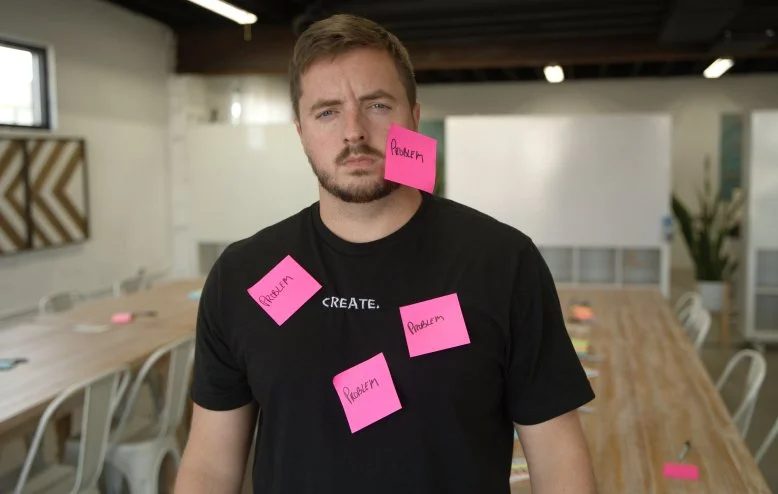
Every pink square is somebody's actual problem. I wore them home.Process beats brilliance, and it scales.
A genius fixes one room. A method fixes the next two hundred and forty-nine.Baton Rouge. GateCheck — a virtual ID and training app for the people who badge into chemical plants. Shell, Chevron, a hundred-plus workshops with the workers themselves.
What I actually did there was notice things and try to build. Workshops with every employee. Workshops with linemen. Safety protocol, gate access, the quality of the courses, printing ID badges, apps, a long list of other things. I even taught a class once, for some reason.
Version one of GateCheck was excellent, in a conference room. Out at a plant gate at it was useless. Cold hands. Work gloves that don't register on a screen. One bar of signal. A line of trucks behind you and a guy who has been awake since four and is not interested in your onboarding flow. Every assumption we'd made was made indoors, by people who were warm. So we went and stood out there and rebuilt it for gloves and bad signal. Security-check failures dropped twenty percent, course completion went up ten. None of that came out of the conference room. It came out of the parking lot.
But that's not what those two years were actually about.
I came in wanting to make huge changes to the world, and to show my worth through the things I produced. I knew products. What I did not understand is that people inside an organization have a culture — and a product does not change a culture. A person rarely changes one on their own either.
Boats make a wake. Be aware of how your decisions move the water around the people next to you. And separately, though it turns out not to be that separate: .
By the time I could see my own wake — could see that my discoveries were landing on the people around me as something other than good news — it was hard to turn back. What I had wanted was to build products that helped save lives. What I actually learned is that change takes time, and that patience was a fundamental requirement for me being any good at this.
So I quit and started my own company. Not always great at taking my own medicine, I guess.
Boats make a wake. Watch what your decisions do to the water around you.
A product doesn't change a culture, and one person rarely does either. Change takes time — which means patience isn't a personality trait, it's a requirement.There's a drawer. In it: a biodegradable plastic made out of , a koozie, juice packaging, beauty products, a security-services platform. Years of nights and weekends.
Most of them failed. That's the honest number and I'd rather print it than round it.
The crawfish plastic is the one that still gets me. It was real chemistry, it genuinely worked, and it was still not a business — because nobody was standing around waiting for it. I had fallen in love with how clever it was, which is a different thing entirely from somebody needing it.
An invention and a business are different animals, and I paid full retail to learn the difference. What survived all of it isn't a product. It's the habit of asking who is already unhappy about this, before I ask what I could build.
Fall in love with the problem. Stay suspicious of your solution.
I'd pay for that lesson again. I would, however, prefer not to.John Hawley and I started Stale Chips in 2021. Five years since, across the Navy, the Air Force, the Army and the NYPD.
Resource prioritization for NAVFAC. A long-range plan an Army installation is still running on through 2030. Offline, local AI for the places where the network is not coming, ever, no matter how many slides say otherwise.
The thing everybody says about government is that it's slow. That is not what I've found. The people in the room are sharp and they want to move. What they've been handed is a fuzzy problem.
Fuzzy meaning: nobody can see it clearly. The problem gets declared at the top, built out of assumptions. Then the people who have to build the solution build it out of their assumptions about which assumptions the top assumed. A lovely spiral of guess and check. A more inefficient process has yet to be uncovered. A thousand monkeys typing Shakespeare comes to mind.
My favorite example, and I promise this one is real. A guy needs a computer for himself and his colleague, so he requests two. His boss says: too small, not worth my time. He requests five. Too small, not worth my time. He requests . Instantly approved.
So a team of two now has eighty-three backup computers sitting on hand. Nobody in that chain did anything wrong. Every incentive worked exactly the way it was designed to. The problem was just never sharp enough for anybody to see what it was doing.
The best proof I have of the other direction came out of a corporate room rather than a government one: roughly , in two days. We didn't do the cutting. We put the criteria in front of the people who'd have to live with the answer and they cut it themselves, fast, because for the first time the question was answerable.
Sharpen the problem until the decision makes itself.
Almost nobody is stuck on the answer. They're stuck on a question so fuzzy that guessing is the only move left.December 2023, St. Pete Pitch Night. I got up there with Fedscribe, an AI proposal writer I had built mostly so I would stop hating my own Tuesdays. It won five thousand dollars.
And then, standing there holding a novelty check that is genuinely , I realized I had pitched the wrong thing. The tool wasn't the prize. The prize was noticing that the AI work now paying real bills had been sitting inside a side project the entire time, and I had very nearly filed it under "cute."
Nothing about that tool was visionary. It fixed one bad afternoon that I personally had, every week, on schedule. That turns out to be the most reliable market signal I know of.
The check was big in both senses. The lesson was bigger.
Build the tool that fixes your own Tuesday. That's the one with a market.
If you won't use it on a bad week, nobody is going to use it on a good one.We found St. Pete because our RV couldn't get over a bridge. I've seen a lot of places. I mean the sentence.
A 1987 Tiffin Allegro. Old Bertha. One day called me out of nowhere to say Bertha was one of maybe three left running in the country. I have no way to verify that. I have never once wanted to.
What Bertha could not do was elevation. No hills. No big bridges. We planned entire weeks in Google Maps on , because it's the only routing that avoids a climb.
So: moving at the speed of a herd of turtles, through utterly rural America, staying at RV parks where ninety percent of the population was a retiree named John, working remote on projects I wasn't really tapped into — we saw parts of a world I had probably spent most of my adult life running from. The South.
Ridiculous way to travel. Also the speed you're supposed to see a country at.
Flat the whole way. Backroads, no bridges, several extra hours, and a left turn we weren't planning to make. This is how we actually got here.
We were headed to Naples. Liz's uncle said "St. Pete" once, in passing, not even as a recommendation. Just a name in a sentence. So we came through.
And it was the list. The one Liz and I had been saying out loud to each other for two years without knowing it was a place. Walkable. Food and drinks. A soccer team. Parks, water, beaches. Young and loud and still old enough to have a history. Visibly on the way up. Almost none of the crime we both grew up next to. Alive.
We sold the RV and signed a lease two weeks later. September 2021. You know when it's it.
It felt like America and somehow a little like Europe too. Close enough to get home fast if family needed us, far enough to make our own stories. So we did. Liz and I got married here, at the . Made friends here. Made businesses here. Made memories here.
First place: three hundred and fifty square feet in a 1924 house. That was the whole apartment, not one room of it. Mold. Then termites — bad enough that for a stretch we couldn't cook dinner or turn the lights on inside our own house. We loved every minute of it. We still talk about that apartment the way people talk about a good year.
The hard part I didn't see coming: finding a new dream is harder than chasing an old one. I've made that swap badly before — chapter three, where I put a person in the empty slot. This time I put a city in it, and a city can't leave.
I also haven't met nearly as many people here as I want to, which is an embarrassingly solvable problem that mostly requires showing up. So the list grows. Hurricane comms that still work when the towers are down. A checker for the same setback and lot-coverage rules the Development Review Commission actually applies. A teardown of the city's permitting process, done the only honest way available — by filing through it myself. Leadership St. Pete, class of 2026, largely so I stop being a stranger.
There's no failure in this chapter and I'm not going to invent one to make the page match. Our life is this city. Our future is its future.
Failure isn't there. Only opportunity.
We found the best place we've ever lived because our RV couldn't climb a hill. I'd be careful about calling your constraints bad luck.I don't know if my life reads as one full of direction, as a spinning top, or pure chaos.
I've been beyond fortunate that despite my incessant need for dreams, adventures, and learning, I've managed to carve out a little life for myself.
But at some point you have to be honest with yourself. My parents are better than me. They make a bigger impact on the world — wildly positive — than I currently do. I help big companies and big government. Twelve years of making other people's problems my love and my focus. Twelve years of making an impact somewhere far from my front door.
So, the intent and the ambition: apply my odd ability to uncover, improve, throw out, research, and experiment with any problem, on any topic, with any group of humans — to the world's greatest city. St. Petersburg.
Make civic St. Pete my driving northern star and see how, when, or where the journey takes me. Mayor of St. Pete? A nice title. Learning from my parents: be the change and the role will find you.
Of course, since we're dreaming — a fall home in , Spain for hurricane season would be a lovely addition. Go check out Llanes. Actually — don't. It's mine and I called dibs.
Be the change and the role will find you.
Nobody appointed my mom to anything. She built a children's museum and kept it open for twenty-eight years. That's the version of a title I'd actually want.Eleven chapters, eleven rules, and honestly not all of them are yours. Tap the ones that landed and they collect here. They'll still be here if you come back.
Nothing taken yet. Scroll back up and grab one —
there's a small button on every gold card.